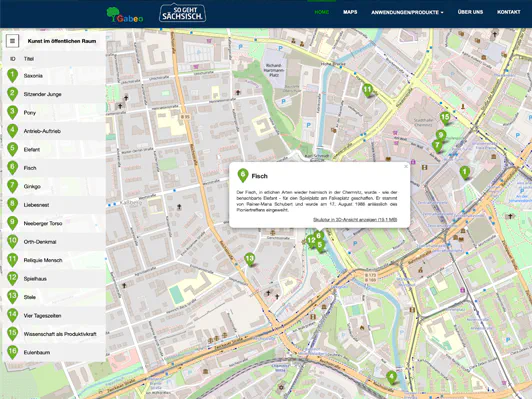
Together with the Chemnitzer Geschichtsverein (Chemnitz historical society), we are making art in public space a digital experience. With the digital sculpture map, Chemnitz residents, art enthusiasts, and hopefully many visitors from elsewhere can take a virtual walk through Chemnitz's art and sculpture landscape.
During the coronavirus pandemic, the main thing heard among people working in the cultural sector in Chemnitz was: We should remain visible and audible in the crisis. Likewise, Chemnitz's bid for European Capital of Culture 2025, under the title C THE UNSEEN, called for more visibility for art and culture in Chemnitz.
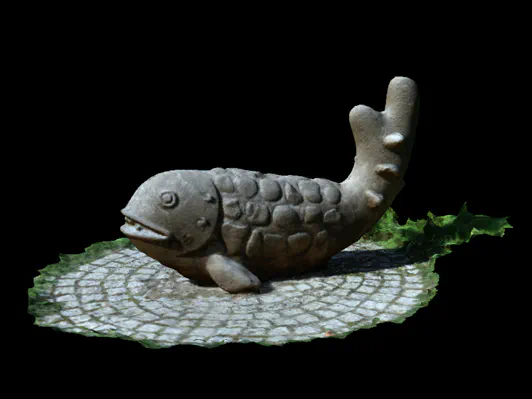
This was also on the mind of Dr Sebastian Liebold of the Chemnitzer Geschichtsverein. In close cooperation with our map team, a digital map was created that provides information on “art in public space” in Chemnitz, primarily in the form of figurative sculptures. A special highlight: Some of the sculptures are available as 3D models that can be virtually circled with a click of the mouse.
Sebastian Liebold's hope: “Perhaps this will also give people from elsewhere, who first heard of Chemnitz when it was awarded the title of European Capital of Culture 2025, a taste for it. The sculptures in the urban space have so far hardly been in the public eye; perhaps we as an association can change that a little.”
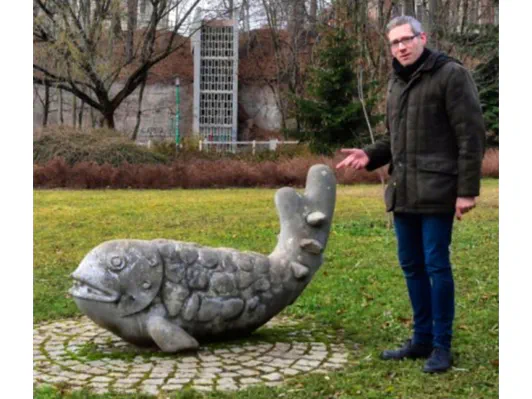
For capacity reasons, it has not yet been possible to include all the figures that one or another person will still discover in the city. But there are already further ideas and activities. A video has been produced to briefly introduce the project “Art in Public Space - Digitising Sculptures”. For the video, one of the sculptures – a fish by artist Rainer-Maria Schubert, installed in 1988 in the park at Falkeplatz – was sent as a 3D model to the city church St. Jakobi, and pastor Dorothee Lücke explains why the fish is a Christian symbol.
Further figures are to be presented in a similar way in a small series in 2021, in unusual places and in a new context. “With the 3D prints, we also want to encourage children and young people in the future to rediscover art in Chemnitz. Perhaps the sculptures reprinted in white could also be set up together in one place in a kind of ‘parade’, and schoolchildren could paint them with Chemnitz motifs?” Sebastian Liebold continued. Will even die-hard art lovers be amazed at how many sculptures our city has to offer?
We thank Dr Sebastian Liebold, Dr Ilja Kogan, Dr Ullrich Scheunert, and pastor Dorothee Lücke for their joint efforts!
Link to the digital sculpture map
Link to the podcast: Art in Public Space – Digitising Sculptures
Link to the Freie Presse article: Digitaler Kunstwerke-Katalog: Ein Fisch geht ins Netz from 22 December 2020
Link to the TAG24 article: Geschichtsverein initiiert digitalen Wegweiser für vergessene Kunst from 9 January 2021
Image credits (from left to right):
Gabeo sculpture map: art in public space; Sebastian Liebold with the fish sculpture by Rainer Maria Schubert, Freie Presse article from 22 December 2020 - photo: Matthias Zwarg; 3D model of the fish sculpture - Gabeo sculpture map