
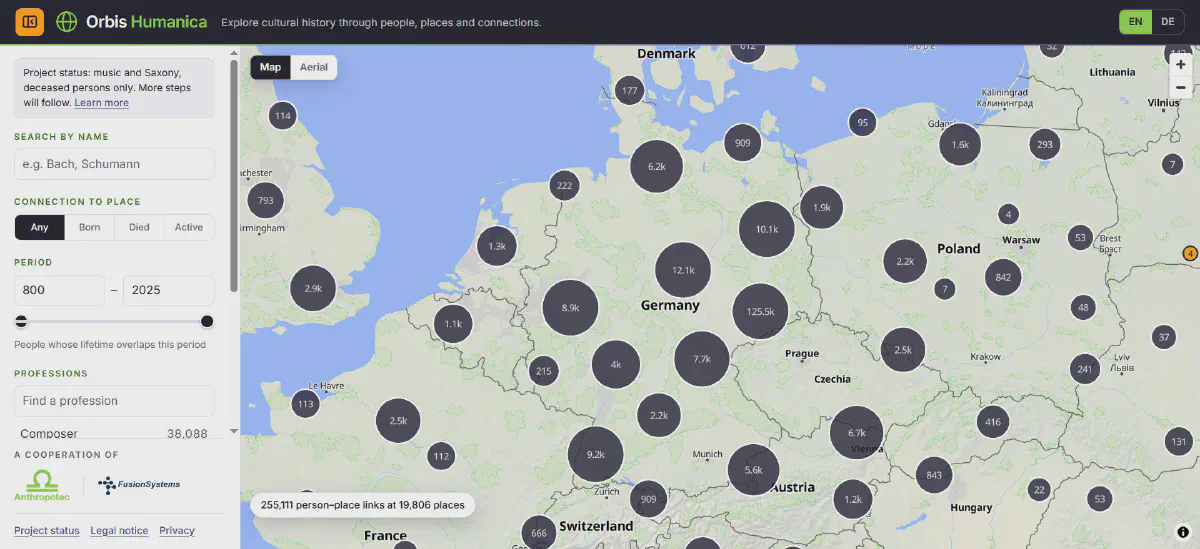
Where was a composer born, where did a cantor work, and who lived in the same place at the same time? Orbis Humanica answers such questions on a map. The platform is freely accessible at orbishumanica.org.
The idea behind it: a digital twin of cultural history. Just as a digital twin represents a machine or a city in the computer, Orbis Humanica represents the world of historical persons, with their places, their dates and their professions.
Orbis Humanica was created in cooperation between FusionSystems GmbH and Institut Anthropotec e.V. Both are based in Chemnitz, Germany.
Making the Integrated Authority File visible
The basis is the Integrated Authority File (Gemeinsame Normdatei, GND) of the German National Library. Libraries, archives and museums in the German-speaking countries use this register to identify persons and places unambiguously. Orbis Humanica makes these data accessible on a map.
Around 168,000 persons
The first stage covers around 168,000 persons: everyone who practised a musical profession, and everyone who was born, died or worked in Saxony. Living persons are not included.
What the map shows
- The map can be narrowed down by name, profession and period.
- It distinguishes places of birth, death and activity.
- A click on a place shows the persons behind it; a further click leads to the GND record.
- The platform is available in German and English.
Open data
The data come from the GND and from Wikidata and are available under the open CC0 licence.
Further development
Together with Institut Anthropotec e.V. we are extending this digital twin: with a search that also understands descriptions, such as “organ builders in Saxony”, and with further topics and regions. Suggestions and requests are welcome.
To the platform: orbishumanica.org