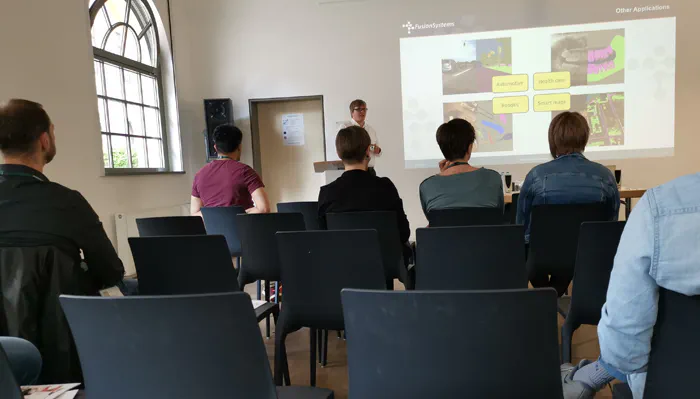
The workshop “Human State Detection in Human-Machine Interaction”, organised by the junior research group KogSYS, took place at Chemnitz University of Technology (TU Chemnitz). It focuses on the helplessness of users of an app, computer program, or ticket machine, which is to be detected in a targeted way. Our colleague Dr Karsten Schwalbe, head of the Mathematical Methods and Algorithms group, gave a talk on “Scene understanding using Convolutional Neural Networks”. The talk focused on how a computer image can be understood by means of a convolutional neural network. This means assigning a class to every pixel by semantic segmentation. Building on this, an understanding of the scene can be generated (“hands in front of the head”) in order to derive a statement about the current state of the person (“helplessness”). The convolutional neural network approach is loosely based on the way the human eye-brain system works and is trained by machine learning. These networks are thus also among the methods of artificial intelligence.