AI Technologies
Sensor Fusion & Physical AI
Combining information from different physical measurement sources – camera, radar, LiDAR, and other sensors – as the basis for systems that act in the real world.

Industries
Environment perception, sensor data fusion and digital environment models, plus AI support for the software engineering process.
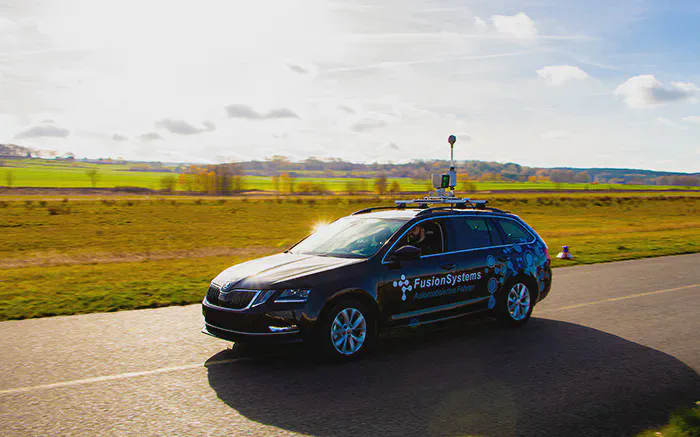
Software development for complex vehicle systems, with requirements management, software architecture and systematic test management, is one of the roots of FusionSystems. We develop detection systems and components for driver assistance and automated driving: vehicle environment perception, navigation, vehicle control, interior monitoring and vehicle communication.
Automated driving needs detection that remains stable in rain, in backlight and under highly dynamic conditions. That is why we test our methods on the road. Our test vehicle carries a multi-camera system for three-dimensional capture, and a 360° laser scanner and a surround-view camera can be mounted on the roof. The measurement data is analysed in the vehicle in real time.
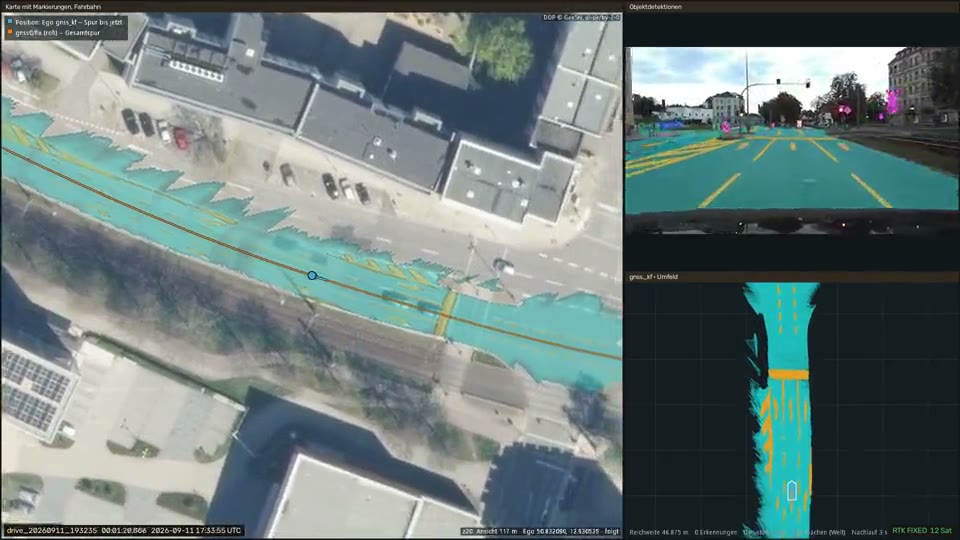
The system detects the roadway and lane markings, traffic signs and traffic lights, obstacles, vehicles and people (see Person Detection). Every detection is localised, classified and rated with a measure of its reliability. We describe the methods under Vision AI and Sensor Fusion & Physical AI.
A position from satellite positioning alone is not sufficient for automated driving. We combine several sources until the position is accurate to the lane:
| Source | Contribution |
|---|---|
| Satellite positioning | Rough initial position; more accurate with correction signals from a reference station |
| Camera and laser scanner | Detected reference points in the surroundings allow lane-accurate positioning |
| Stationary radio modules | Approximate position where no satellite signal arrives, for example in a parking garage |
| High-precision map | Map matching corrects positions with insufficient accuracy |
A state estimator merges the sources and delivers a continuous position even with low signal coverage.
It is not enough to see what is happening in front of the vehicle right now. An automated vehicle must also know how its world is structured, how it changes and which rules apply there. That is why we connect perception in the vehicle with a digital environment model of the operating area. What the vehicle detects during measurement drives is located spatially and entered into this model. The project AI-Based Environment Perception for Autonomous Public Transport shows what this looks like using public transport as an example.
The principle extends beyond the passenger car: to trams, autonomous shuttles, small platforms for micromobility and goods transport, and autonomous machinery.
Our software development follows the V-model. Requirements accompany all development steps and are documented; for safety-relevant software we follow ISO 26262, in the process Automotive SPICE, and in the code the MISRA guidelines.
From this practice, we know the effort that requirements, tests and evidence cause. This is where our solution approach Engineering Intelligence comes in: agents check and consolidate requirements, derive tests, classify defects and link standards with evidence. They deliver suggestions. Binding changes remain subject to review and approval.
AI Technologies
Combining information from different physical measurement sources – camera, radar, LiDAR, and other sensors – as the basis for systems that act in the real world.
AI Technologies
Image-based and video-based AI, grown out of many years of experience in industrial machine vision.
AI Technologies
Every data source has its strengths and limits. The result becomes reliable when text, images, audio, sensor data, and geodata are interpreted together.
Solutions
Detecting, tracking, and understanding people in camera images: position, motion, posture, gestures, and face – with high detection performance and a low false alarm rate.
Solutions
From existing knowledge to a usable engineering system: linking requirements, tests, failure analysis, and evidence with AI.
Projects & References
Perception in the vehicle and the digital environment model of the operating area work hand in hand: what the vehicle detects becomes permanently usable knowledge about the environment.
Whether a first AI adoption or a complex development task – we discuss the requirements and suitable next steps with you.