AI Technologies
Document & Knowledge Intelligence
Making large, heterogeneous bodies of information accessible and turning unstructured information into knowledge models that are usable for the business domain.

Industries
Preserve experience-based knowledge, manage variants, and use image and sensor data to assess condition and quality.
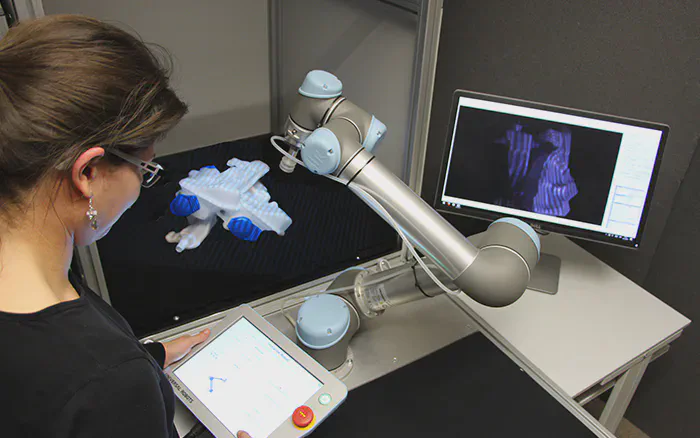
Two paths lead us into industry. One is image processing in production, which has been part of our work for many years. The other is the knowledge contained in technical documents, which is rarely available where a decision has to be made.
Our camera-based quality inspection ranges from shape and dimensional inspection through defect detection to 3D measurement, with 2D and 3D image processing and solutions that combine several sensors. The systems work in the running process or in final inspection.
| Inspection task | What the system does |
|---|---|
| Metal wire and metal strip | Real-time surface inspection of the material as it passes through |
| Hexagonal wire | Three cameras inspect for cracks, scratches and dents; defective sections are cut out automatically |
| Solar cells | Automatic defect inspection |
| Rubber rings | Measurement of different sizes, placed in the measuring station in any position |
| Springs | Position detection and measurement for automatic feeding and assembly |
| Natural stone slabs | Surface inspection according to objectively assessable criteria |
Classical image processing and machine learning complement each other here. Where a feature can be measured, we measure it. Where defect patterns are diverse and hard to capture in rules, we use learning-based methods. Learn more under Vision AI.
In mechanical and plant engineering, much is custom-built. Every enquiry raises the same questions: What comparable systems have we already built? Which modules fit together? What has proven itself, and what led to problems or additional costs? The answers are spread across proposals, requirement and functional specifications, change documentation and service reports.
Our approach aims at more than a better search. Historical projects are broken down into modules, and the modules are described with their properties and relationships. Similarity is then searched for at the level of the modules and in several dimensions at once: function, mechanics, performance, interfaces, cost-effectiveness.
| Benefit | What changes |
|---|---|
| Manage variants | Variants are traced back to existing modular solutions instead of treating each one as a special case |
| Preserve experience-based knowledge | Knowledge that is tied to individual people becomes accessible to the organisation |
| Prepare proposals | Comparable projects and suitable modules are found; the preliminary analysis becomes shorter |
| Learn from the project history | It becomes traceable not only what was built, but why a solution was successful or problematic |
This does not replace engineering work. The AI structures, compares, suggests and creates transparency. People assess, prioritise and take responsibility. We describe the solution approach under Document Intelligence for Mechanical Engineering.
Plants and networks are usually measured at only a few points, and measured values are noisy or faulty. For such cases, we combine physical models and state estimation with learning-based methods. The result is a statement about the condition of the plant that shows how certain it is. We describe the method under Hybrid AI & Decision Intelligence.
With MULI, we are developing our own automated guided vehicle, which moves material between warehouse, machine and assembly. In the funded project InnoTeam RoSa, we combine the mobile platform with an articulated robot arm. The basis is our multi-sensor environment perception, which reliably detects people, obstacles and free paths. Learn more under Automated Guided Vehicles and Mobile Machinery.
The inspection systems are proven practice from projects in the supplier industry, in special-purpose machine building and in other industries. We implement document intelligence and condition assessment together with the user and begin with a clearly defined project. What such a start looks like is described under AI Adoption.
AI Technologies
Making large, heterogeneous bodies of information accessible and turning unstructured information into knowledge models that are usable for the business domain.
AI Technologies
Image-based and video-based AI, grown out of many years of experience in industrial machine vision.
AI Technologies
Machine learning combined with mathematical modelling, rules, and technical system models – for statements that show how certain they are.
Solutions
Understanding documents instead of merely reading them: archives, files, and technical documentation become structured knowledge you can query.
Solutions
From existing knowledge to a usable engineering system: linking requirements, tests, failure analysis, and evidence with AI.
Solutions
Multi-sensor environment perception for machines that move on their own: automated guided vehicles on the shop floor, mobile robots in manufacturing, and mobile machinery in the field.
Solutions
Detecting, tracking, and understanding people in camera images: position, motion, posture, gestures, and face – with high detection performance and a low false alarm rate.
Projects & References
From document archive to knowledge architecture: historical project documents become the basis for faster proposals and secured experience-based knowledge.
Whether a first AI adoption or a complex development task – we discuss the requirements and suitable next steps with you.