AI Technologies
Sensor Fusion & Physical AI
Combining information from different physical measurement sources – camera, radar, LiDAR, and other sensors – as the basis for systems that act in the real world.

Tested in road traffic
Perception in the vehicle and the digital environment model of the operating area work hand in hand: what the vehicle detects becomes permanently usable knowledge about the environment.
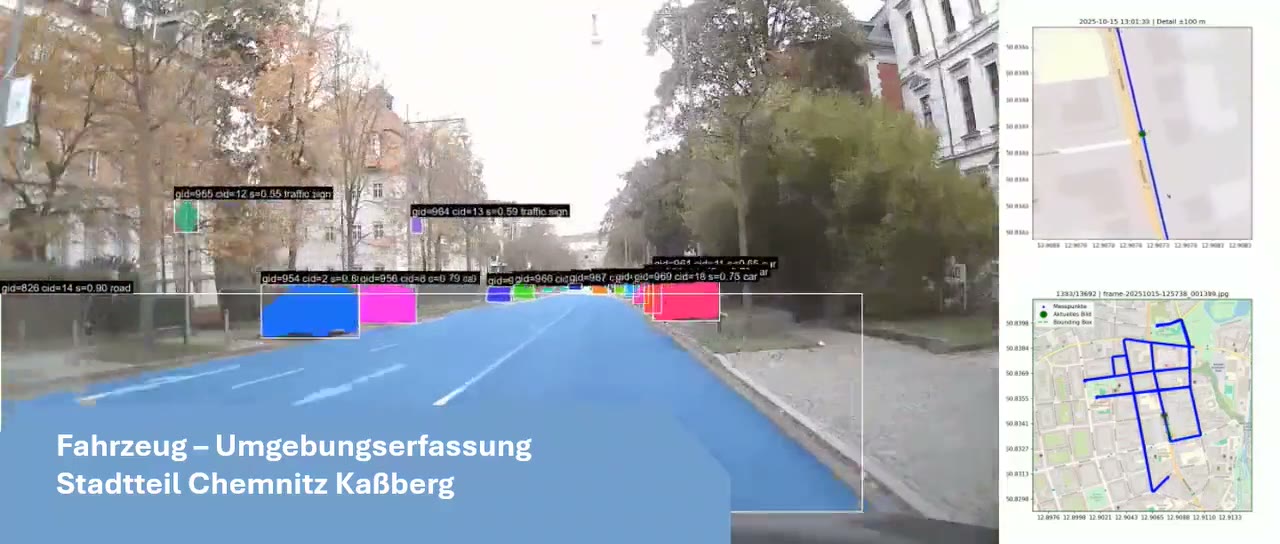
If a vehicle is to make decisions without a driver, it is not enough to see what is happening in front of it right now. It also has to know how its world is structured, how that world changes and which rules apply there.
The same principle extends beyond the tram: to autonomous shuttles, micromobility and goods transport as well as autonomous mobile machinery.
| In the vehicle | In the operating area | |
|---|---|---|
| Task | Capture the immediate surroundings in real time | Model the environment over the long term |
| Sources | Camera, LiDAR, radar, satellite positioning | Digital twin, high-precision map, cadastral and traffic data |
| Result | Objects, traffic signs, lanes, other road users | Context for decisions, basis for planning and simulation |
The same methods that the vehicle uses in operation build and maintain the knowledge about the environment, automatically and continuously. Because traffic spaces change: construction sites appear, vegetation grows.
AI Technologies
Combining information from different physical measurement sources – camera, radar, LiDAR, and other sensors – as the basis for systems that act in the real world.
AI Technologies
Every data source has its strengths and limits. The result becomes reliable when text, images, audio, sensor data, and geodata are interpreted together.
AI Technologies
Image-based and video-based AI, grown out of many years of experience in industrial machine vision.
AI Technologies
Analysing spatial information intelligently and combining it with visual and other data.
Industries
Environment perception, sensor data fusion and digital environment models, plus AI support for the software engineering process.
Whether a first AI adoption or a complex development task – we discuss the requirements and suitable next steps with you.