AI Services
AI Development
We develop the methods that turn your data into reliable results: machine learning, AI pipelines, agents, multimodal analysis, and hybrid models.

Solutions
Understanding documents instead of merely reading them: archives, files, and technical documentation become structured knowledge you can query.
Companies and organisations with document-intensive processes, large archives, or distributed experiential knowledge.
A single language or vision model does not reliably resolve ambiguities in names, places, and spellings. Only the combination of model, knowledge base, and normalisation delivers a robust result.
A document is not a collection of letters. It is a multimodal object made of text, images, characters, and layout, and much of its information becomes understandable only in the overall context.
| Example | What the system does |
|---|---|
| Historical music prints | Detect page types; capture title, composer, publisher, printer, dedication, and year and match them against the Integrated Authority File (Gemeinsame Normdatei, GND) |
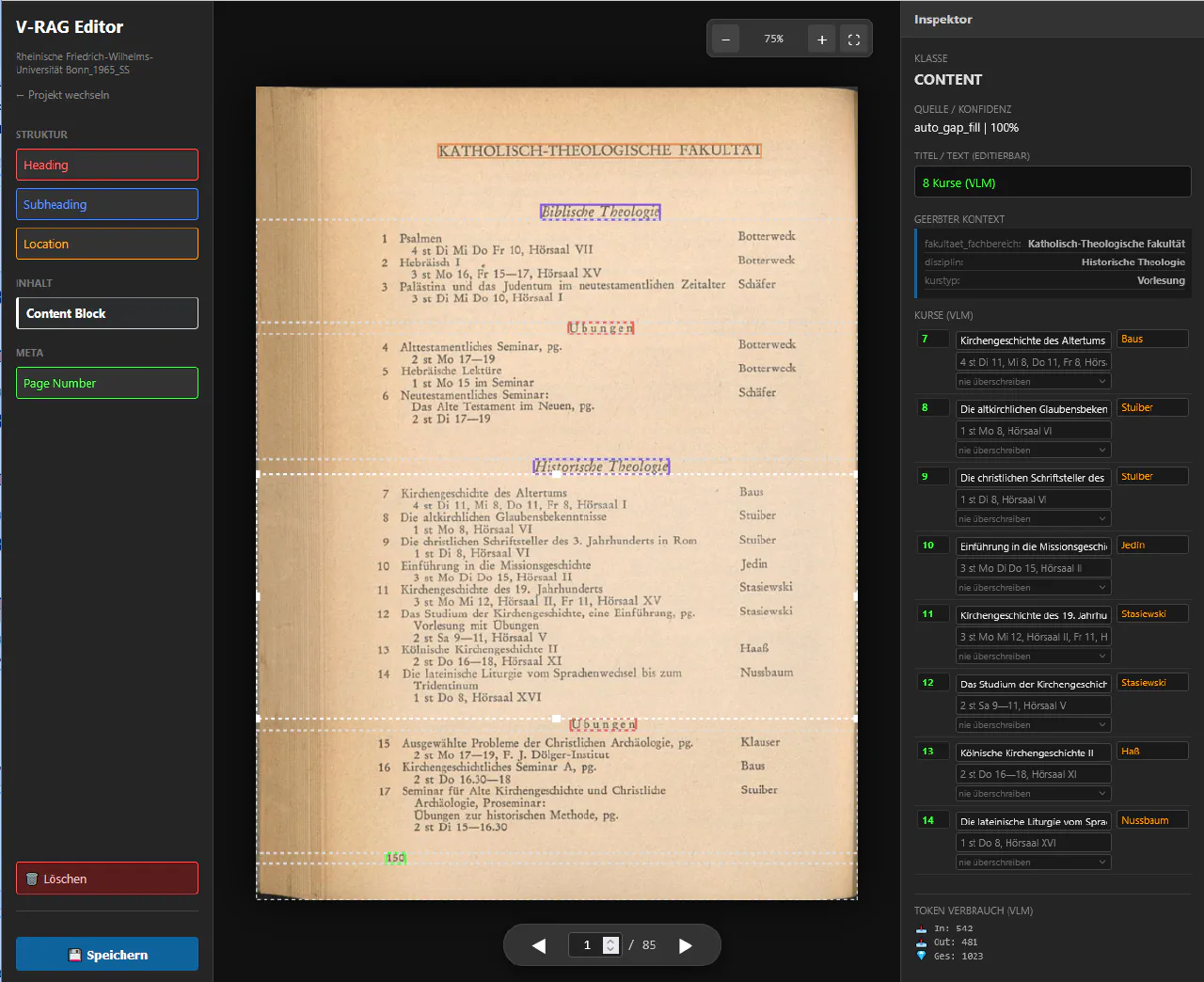
| Course catalogues | Scans from several decades: automatic cropping, layout analysis, text recognition with a vision-language model, human review, export |
| Concert programmes | Large volumes of highly varied documents: analysis, structuring, database, plausibility check, export |
| Early modern ordinance in Kurrent script | Transcription, scribe profile, normalisation of places and persons, uncertainty statements with justification |
| Household encyclopedia of 1728 | Transcription and knowledge assistant: questions in natural language, answers with the specific source references |
For technical documentation, we describe the same approach using machine tool manufacturing as an example: Document Intelligence for Mechanical Engineering.
AI Services
We develop the methods that turn your data into reliable results: machine learning, AI pipelines, agents, multimodal analysis, and hybrid models.
AI Services
AI becomes usable where the work is done: as a function in existing software, as an interface, or as a separate application in your system landscape.
AI Services
The environment in which your AI is allowed to work: model access, data connection, access rights, and operations, as the foundation for every further application.
AI Technologies
Making large, heterogeneous bodies of information accessible and turning unstructured information into knowledge models that are usable for the business domain.
AI Technologies
Individual model calls become controllable systems based on a division of labour: specialised agents handle subtasks, use tools, and work together in verified workflows.
AI Technologies
Every data source has its strengths and limits. The result becomes reliable when text, images, audio, sensor data, and geodata are interpreted together.
Industries
Preserve experience-based knowledge, manage variants, and use image and sensor data to assess condition and quality.
Industries
Unlock company knowledge, analyse documents and support cases with internal AI assistants.
Projects & References
From document archive to knowledge architecture: historical project documents become the basis for faster proposals and secured experience-based knowledge.
Whether a first AI adoption or a complex development task – we discuss the requirements and suitable next steps with you.