AI Technologies
Vision AI
Image-based and video-based AI, grown out of many years of experience in industrial machine vision.

AI Technologies
Every data source has its strengths and limits. The result becomes reliable when text, images, audio, sensor data, and geodata are interpreted together.
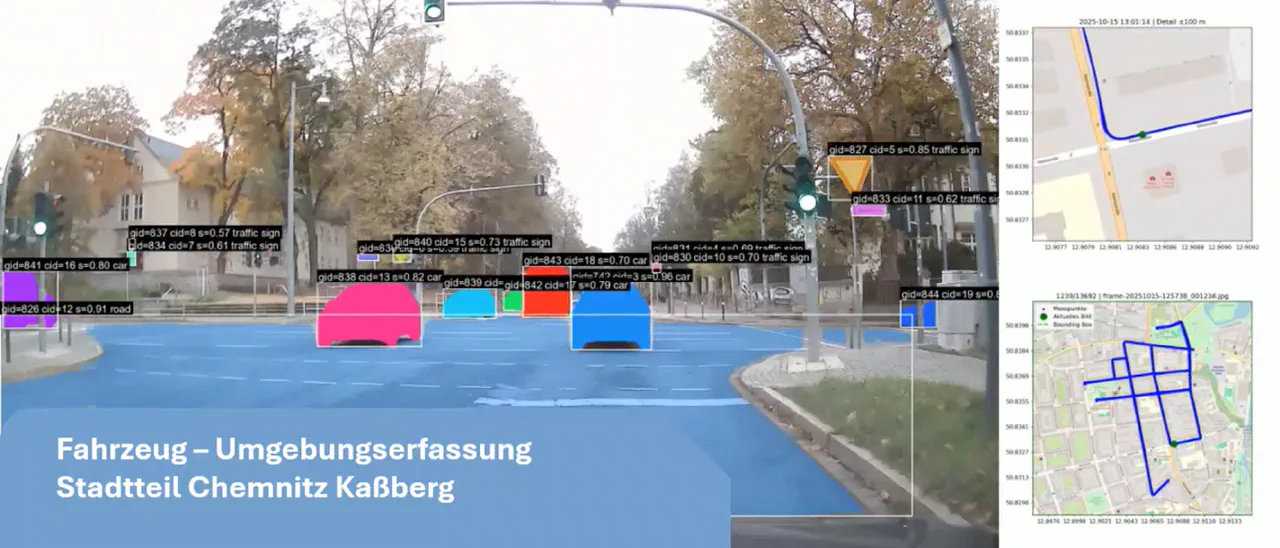
We have been working on the fusion of sensor data since the company was founded. Today we supplement images, radar data, and laser data with texts, symbols, databases, maps, and standards. Sensor fusion becomes multimodal AI.
A traffic sign in a camera image is small, often weathered, partially occluded, or backlit. We combine three paths to recognition:
| Path | What is merged | Effect |
|---|---|---|
| Textual fusion | Semantic search in a knowledge base with official standards data | The context is enriched with descriptions |
| Visual fusion | Text and image section | Higher precision through image analysis |
| Multimodal fusion | Text, image section, and standardised example symbols | Robust through comparison with the reference image |
A vision-language model evaluates the image section together with this context. We distribute the work steps among specialised agents; a quality mechanism checks whether the decision is plausible and sound.
Historical documents seem far removed from autonomous mobility. Technologically they are very similar: complex visual structures, texts, characters, layouts, and relationships that only emerge from the whole. That is why we transfer our approach from vehicle perception to documents, geodata, and engineering data.
AI Technologies
Image-based and video-based AI, grown out of many years of experience in industrial machine vision.
AI Technologies
Combining information from different physical measurement sources – camera, radar, LiDAR, and other sensors – as the basis for systems that act in the real world.
AI Technologies
Making large, heterogeneous bodies of information accessible and turning unstructured information into knowledge models that are usable for the business domain.
Solutions
Understanding documents instead of merely reading them: archives, files, and technical documentation become structured knowledge you can query.
Projects & References
Perception in the vehicle and the digital environment model of the operating area work hand in hand: what the vehicle detects becomes permanently usable knowledge about the environment.
Whether a first AI adoption or a complex development task – we discuss the requirements and suitable next steps with you.